
One thing is for sure when it comes to Google search – Google is always going to be changing the rules of the game. It is not a “set it and forget it” effort for your auto repair shop’s website.
To make it to the first page of the search results and stay there you’ve got to keep up with Google’s evolving preferences. And to Google’s credit – they make these adjustments in their continued pursuit to give their search engine users the best answers to the questions they are asking.
The good news is that Whitespark recently released their 2026 Local Search Ranking Factors survey results. This is a treasure trove of data and information on everything related to local search. It includes 47 local search experts answering in-depth questions about what is working and what is not. We’ve already covered how to boost your auto repair shop’s visibility in Google Maps and the Local Pack.
In this blog we are going to cover organic search, or what you may think of as traditional Google search.
What is organic search?
The organic search results are the list that usually starts right below the Local Pack and map on the search engine results page (SERP). It is your website that drives these organic search results. Page 1 usually includes 8 to 10 organic results. These are the only results that you used to see for a search conducted 15+ years ago.
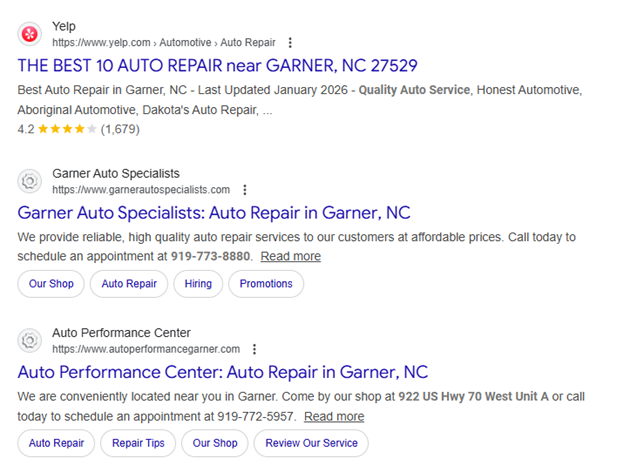
Even though they’ve been pushed down the page, the organic results are really important because more people click on an organic result than any other area of the SERP.
Top 10 factors affecting organic search results
The survey included 187 factors and asked the experts to rank them in order of importance. Here are the Top 10 factors:
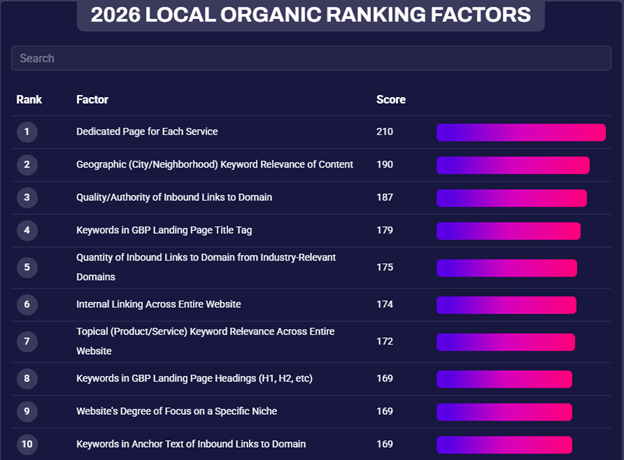
Instead of just doing a deep dive into the Top 10 factors, we are going to segment them by key themes and cover them in those groups.
Content reigns supreme
Based on the results, it is clear that content is still very important in both breadth and depth. A five-page website is not going to get it done for you. Here are the content-focused factors in the Top 20:
- #1 – Dedicated Page for Each Service
- #2 – Geographic (City/Neighborhood) Keyword Relevance of Content
- #7 – Topical (Product/Service) Keyword Relevance Across Entire Website
- #9 – Website’s Degree of Focus on a Specific Niche
- #14 – Volume of Quality Content on Entire Website
- #17 – Volume of Quality Content on Service Pages
The number one factor is having a dedicated page for each service. That’s pretty straight forward. If you want your website to search well you need to have a dedicated page for each automotive service you offer – brake repair, oil changes, engine maintenance, etc.
While keywords are not the number one focus area for search supremacy, they are still important. As you can see with #2 and #7, both location and topical keywords play a significant role in how your website will perform in search. However, it’s important to note that the days of keyword stuffing are long gone. The copy throughout your website should naturally highlight the location(s) you serve and the services you provide. When somebody searches for automotive services in your area Google wants to serve them up the best choices. Help Google realize that your shop should be on that list.
Focusing on a specific niche, factor #9, should not be difficult for auto repair shops. Make sure you are thorough in covering the automotive services you provide and how you help customers. Question and answer format is also highly favored by Google right now. Include all those things and it will be clear to Google that vehicle maintenance and repair is your specific niche.
The last two factors relating to content in the top 20 focus on the volume of quality content. The Google algorithm is a lot smarter than it used to be. It can tell whether the content on your website is actually helpful or just fluff. You need to have quality content throughout your website and especially on service pages for Google to rank you above your competitors. Mindlessly asking ChatGPT to write your content isn’t going to work.
Inbound links demonstrate credibility
Links from other websites to your website are still significant to Google when it comes to proving your credibility, especially considering these top-ranked factors:
- #3 – Quality/Authority of Inbound Links to Domain
- #5 – Quantity of Inbound Links to Domain from Industry-Relevant Domains
- #10 – Keywords in Anchor Text of Inbound Links to Domain
- #12 – Diversity of Inbound Links to Domain
- #13 – Quantity of Inbound Links to Domain from Locally-Relevant Domains
Google sees inbound links from other websites as strong referrals for your business. As you might guess, the more credibility a website has (#3) the more credibility it provides to your website when it has a link to it.
The more links you have from other auto repair/aftermarket websites (#5), the better. For an auto repair shop, being a part of a program, like the Auto Value or Bumper to Bumper Certified Service Center program, is significant for this one. The programs always have links to their shops. You can also be helped by other suppliers, organizations or businesses you are involved with.
As far as #10, it would be great if every link to your website had the words best auto repair shop in [your city], but it’s good to just be thankful for the link and not worry about getting the best possible text for it.
Numbers 12 and 13 technically had the same number of points. We would encourage you to strongly favor #13. We’ve been encouraging our clients for years to ask for links to their website from community organizations they are already sponsoring or participating in. This could be a local chamber of commerce, a youth sports team, a special event or even a local church. You are not competing against every repair shop in the United States, you are competing against the other repair shops in your area. These types of local links can have a big impact on your search results.
Technical SEO still matters
Technical SEO is an area where you are not likely to gain a lot on your competitors, but you will definitely lose if you are not taking care of the fundamentals. The most important pieces include:
- #4 – Keywords in GBP Landing Page Title Tag
- #6 – Internal Linking Across Entire Website
- #8 – Keywords in GBP Landing Page Headings
- #11 – Keywords in Title Tags Across Entire Website
- #15 – Keywords in Headings Across Entire Website
- #16 – Mobile-friendly/Responsive Website
- #18 – Website Uses HTTPS by default
- #19 – Keywords in Anchor Text of Internal Links
The first thing that may jump out at you here is that this is the longest list. The second thing may be that there are key themes built around keywords, title tags, headings and internal links.
Think of title tags as book titles. Each page of your website has a title and it is called a title tag. Headings are like chapters. Each page of your website will also likely have an H1 heading, followed by H2s and maybe H3s. The headings are labeled based on importance, not order.
The combination of the title tags and headings help Google understand the bigger picture of what each page of your website is about. That is why using keywords in those two areas are so important. It helps Google quickly evaluate what your website is all about and for what searches your pages should show up for in search results. These should work similarly to an outline or table of contents for a training guide or instruction booklet that helps you drill down quickly to the specific issue that you are looking for guidance on.
For factor #4 – you especially want to do a good job of making sure that the page your Google Business Profile links to has keywords in the title tag. This is usually your home page, but not always.
Internal linking (#6) includes links on the pages of your website to other pages on your website. This is a place where a lot of websites fail. They don’t include these links. You absolutely need to take advantage of this opportunity. What’s also great is that unlike inbound links from external websites, you can control the anchor text of these links (#19). Be sure to use that to your advantage as well.
Organic search is still a key piece of your web presence
Consumers are still consistently using Google to search for auto repair shop services online. They are then scrolling down to the organic results to determine which shop they will be reaching out to. Focusing on the factors highlighted above will give your website the best chance to outperform other auto repair shops in your area, rise to the top of the search results and capture this valuable consumer business.
If you need help optimizing your website to search well on Google, give us a call at 919-398-6171 or send us an email at team_rsw@repairshopwebsites.com.